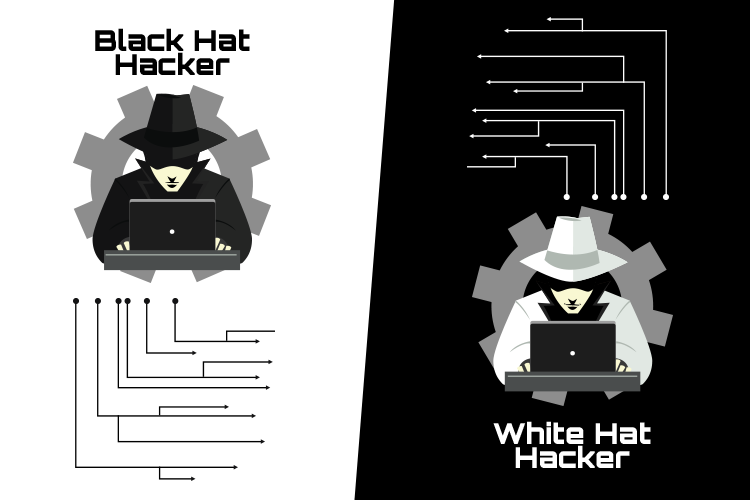
which two types of hackers are typically?
Black hat hackers do criminal acts of destructive activity that are motivated by political, personal, or just
the thrill of doing harm. Ethical cybersecurity specialists known as "white hat" hackers strive to fortify
security by carrying out approved tests to find and address flaws. They take transparent, lawful action with
the intention of safeguarding systems. The difference is in intent and ethics: white hats have protective,
ethical goals, while black hats have malevolent intent.
White hat Hacker
In the realm of cybersecurity, ethical hackers, or "white hat" hackers, are essential. They use what they know
and the abilities they possess to find and fix security flaws, which improves digital security in the process.
The following are important facts regarding white hat hackers:
1. Intentions and Ethical Stance:• The aims of white hat hackers are honorable and moral. Their
main objective is to proactively find vulnerabilities in systems, networks, and applications in order to improve
cybersecurity.
• They obey moral and legal requirements when conducting business. The organizations they
work for or the people who hire them have approved and sanctioned their actions.
2. Roles and Responsibilities: • Penetration Testing: Hat in white Hackers frequently perform
penetration testing, which involves modeling cyberattacks to find holes in a system's security. This aids
businesses in bolstering their security protocols.
• Vulnerability Assessments: To find and examine potential vulnerabilities in software, networks, and
infrastructure, they carry out exhaustive evaluations.
• Security Audits: White hat hackers conduct audits to make sure that a company's security procedures and
policies follow industry best practices and standards.
3. Skill Set:• A wide range of skills, including programming, networking, cryptography, and
several cybersecurity technologies, are possessed by white hat hackers.
• Because of their understanding
of various cyberthreats, hacking methods, and security procedures, they are able to foresee and thwart possible
attacks.
4. Certifications:• A lot of white hat hackers are certified in order to verify their knowledge
and proficiency. The Certified Information Systems Security Professional (CISSP), Certified Ethical Hacker
(CEH), and Offensive Security Certified Professional (OSCP) are examples of common certificates.
5. Collaboration with Organizations:• White hat hackers frequently collaborate closely with
businesses to improve their security posture. This cooperation may entail making suggestions, putting security
measures in place, and training personnel on best practices.
6. Continuous Learning:• White hat hackers participate in ongoing learning to stay current on
new threats, vulnerabilities, and countermeasures because cybersecurity is a dynamic field. They can continue to
be productive in their professions because of this ongoing education.
7. Legal and Regulatory Compliance:• Legal and regulatory compliance is given top priority by
white hat hackers. Before performing any security tests or evaluations, they get express consent, so they can be
sure that everything they do complies with the law.
8. Contributions to Open Source Security:• In order to strengthen the collective defense against
cyber threats, some white hat hackers contribute to open source security projects by sharing their expertise and
resources with the larger cybersecurity community.
In general, white hat hackers are necessary to keep digital systems secure and reliable. Their proactive
strategy assists both individuals and companies in reducing risks and effectively addressing the dynamic
landscape of cybersecurity threats.
Black Hat Hacker
Individuals who participate in hacking activities with malevolent intent are known as black hat hackers. Black
hat hackers, in contrast to white hat hackers who seek to improve cybersecurity, take advantage of
vulnerabilities for their own gain, financial gain, or malicious intent.
The following are important facts regarding Black hat hackers:
1. Malicious Intentions:• Black hat hackers compromise computer security for their own benefit
or to cause harm. They do this with malicious intent.
• Their actions often involve unauthorized access,
data theft, spreading malware, launching cyber-attacks, and other activities that compromise the
confidentiality, integrity, or availability of information systems.
2. Illegal Activities:• Hackers using black hat techniques act beyond legal restrictions. If
discovered, they could be prosecuted for breaking computer crime laws.
• Unauthorized access to systems,
financial or personal information theft, and the spread of malicious software are examples of common unlawful
acts.
3. Financial Motives:• Financial gain is a common motivation for black hat hackers. To extract
money from people or companies, they could take part in ransom attacks, identity theft, or credit card
information theft.
4. Cybercrime Networks:• A small percentage of black hat hackers are involved in structured
cybercrime networks. These networks might be experts at particular kinds of assaults, like malware distribution,
phishing, or hacking.
• Black hat hackers can organize large-scale attacks, share strategies, and pool
resources by working together within these networks.
5. Exploitation of Vulnerabilities:• Black hat hackers can pool resources, discuss strategies,
and plan large-scale assaults by working together within these networks.
6. Botnets and DDoS Attacks:• hat in black Botnets are networks of compromised computers that
hackers can establish and manage to launch massive distributed denial-of-service (DDoS) assaults. These assaults
overload the network infrastructure or servers of their target, resulting in interruptions or outages.
7. Stealth and Anonymity:• Black hat hackers frequently work in secret, hiding their whereabouts
and identities with various strategies. They could use VPNs, anonymizing software, or other techniques to avoid
being discovered by law authorities.
8. Hacktivism:• Hacktivism is the practice of certain black hat hackers mixing hacking with
political or social activity. They could go after companies or people in an effort to further a certain cause or
philosophy.
9. Lack of Morality and Ethics:• Usually, black hat hackers don't give ethical issues a second
thought. Their acts have the potential to seriously damage people, companies, and even vital
infrastructure.
It's important to distinguish between ethical hackers, or "white hat" hackers, who utilize their expertise for
good and black hat hackers. The activity of ethical hackers enhances the general security of digital systems and
networks, whereas black hat hackers use weaknesses for malevolent purposes. To discourage and stop cybercrime,
law enforcement and cybersecurity experts collaborate to locate and apprehend black hat hackers.